
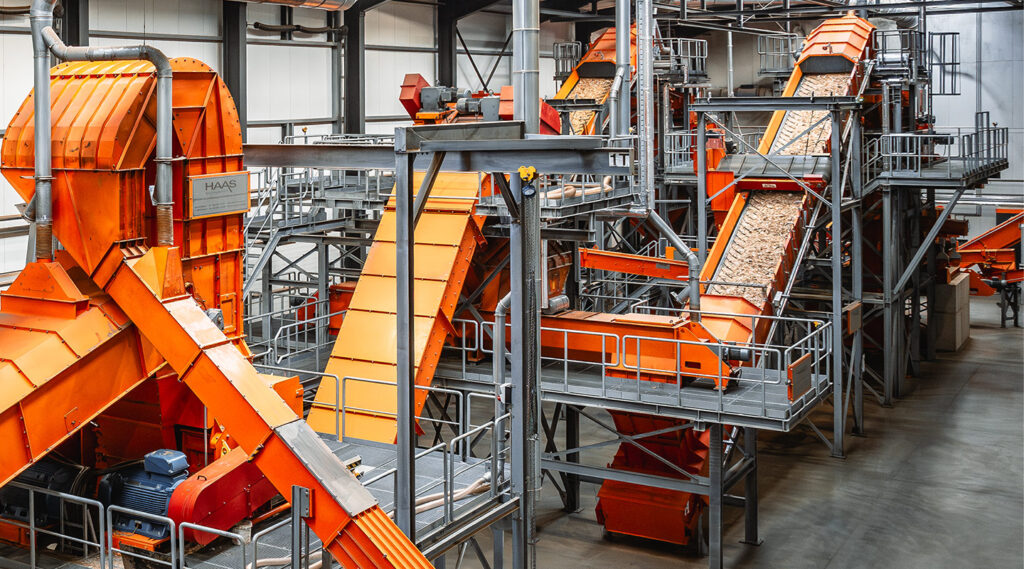
Waste Wood
Processing for biomass power plants
The plant solution produces a high-quality biomass fuel for the operation of biomass power plants.
→ Two conveying lines · 60 t/h
For your industrial material processing
Designed for economical long-term plant operation
HAAS develops and implements processing plants for a wide variety of materials worldwide. Every plant is designed with the goal of ensuring economical, reliable, and adaptable operation for many years. Because the key factor is not only what material you want to process. The real question is what result you need to achieve, both today and with future requirements in mind.
Even successfully realized reference plants cannot simply be copied. Every material places its own unique demands on future plant operation. Materials vary, material flows fluctuate, and requirements for the final product change over time.
Even minor differences can have a significant impact on plant performance. Material characteristics, throughput requirements, available space, operating procedures, and future expansion plans all create new challenges for every project.
The success of a processing plant therefore depends not on a single machine, but on the interaction of the entire process chain, from material feeding and shredding to separation, conveying technology, and control systems. All components must be matched to the material, throughput capacity, and operating conditions.
A high-performance processing plant must be optimally aligned with existing operating procedures and individual requirements. Standard solutions often reach their limits in this context.
That is why HAAS develops customized plant concepts tailored to the material, throughput, and specific process requirements. From shredding and conveying technology to separation systems and plant controls, all components work together seamlessly to create a perfectly coordinated overall process.
The following examples demonstrate how individual plant solutions are developed from differing requirements.
Individually planned. Economically engineered.
The first step in every project is a clear understanding of your material input and operational requirements. Based on this, we work with you to develop a plant concept designed for long-term economic efficiency. Appropriate performance reserves help compensate for material fluctuations, reduce wear, and ensure stable plant operation over the long term.
What you can rely on:
Successfully implemented processing plants
Every HAAS plant is developed based on specific customer requirements.
The following project examples illustrate how different materials, throughput capacities, and site conditions have been transformed into practical and efficient solutions.
Upon request, we can also provide insights into existing reference plants and support you with personal consultation on the path to the right solution.
Waste Wood
Processing for biomass power plants
The plant solution produces a high-quality biomass fuel for the operation of biomass power plants.
→ Two conveying lines · 60 t/h
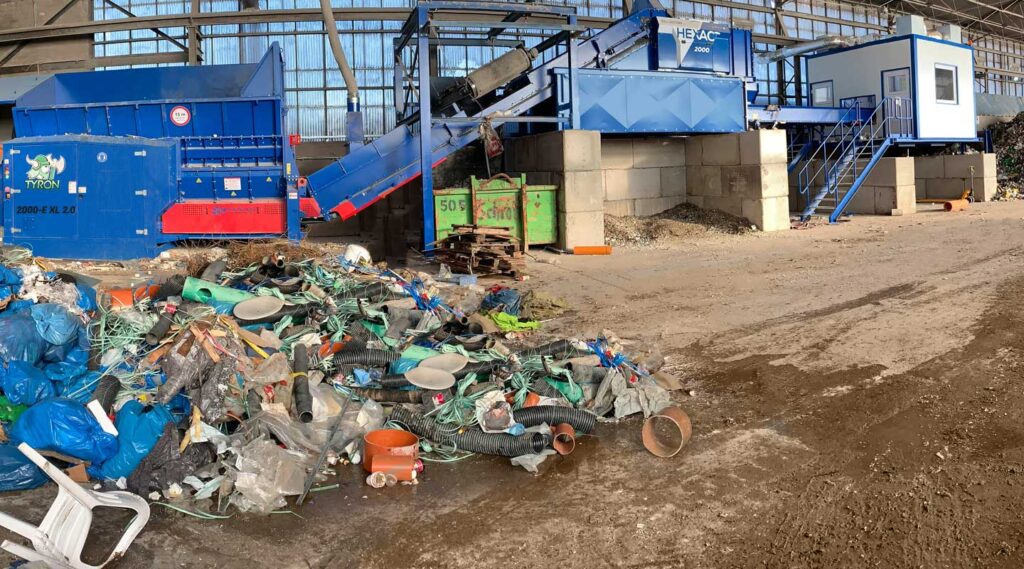
Commercial Mixed Waste
Processing into refuse-derived fuel (RDF)
Variable material streams are processed into a consistent refuse-derived fuel with stable quality.
→ Throughput up to approx. 20 t/h
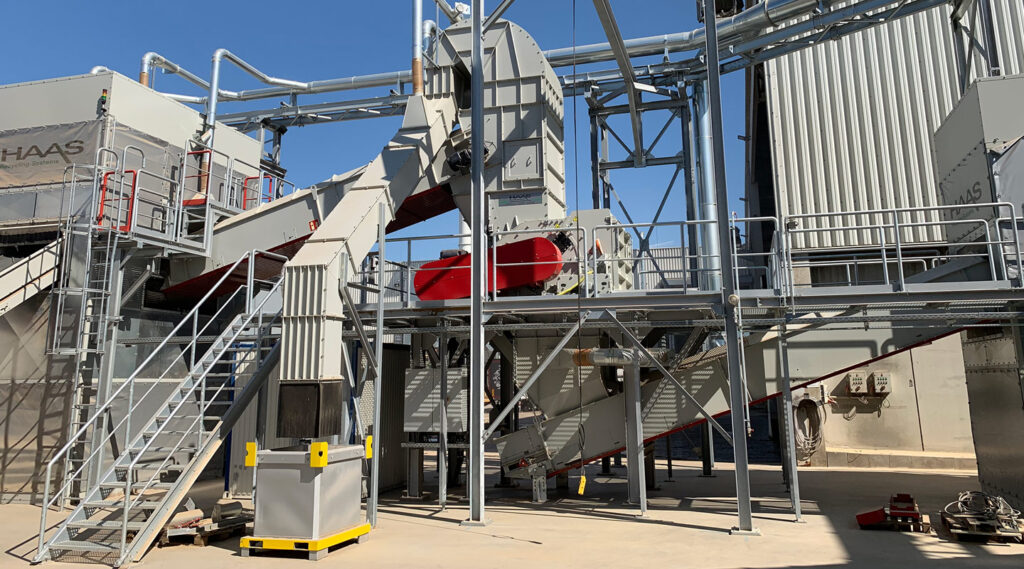
Low-Dust Processing
For sensitive operating environments
The enclosed plant design reduces dust and emissions while ensuring stable process conditions.
→ For sensitive outdoor sites
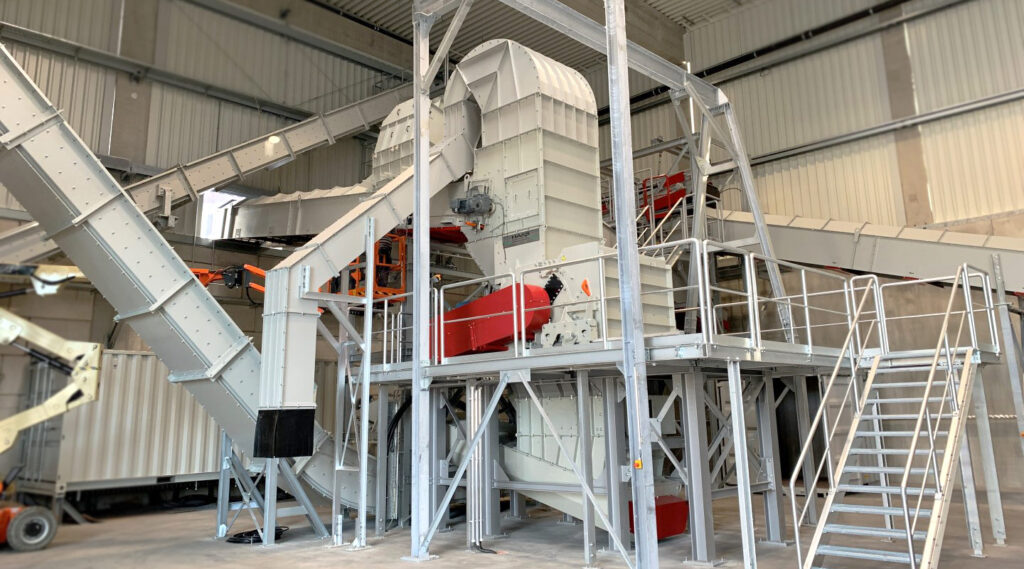
Flexible Processing Routes
For different recovery and utilization requirements
The plant concept makes it possible to adapt material streams to different processing and recovery objectives.
→ Independent line operation
Creating the foundation for high-performance plant operations
A processing plant is designed for many years of operation. In practice, its service life is often 15 to 20 years or even longer.
Over this period, material streams change, processes are affected by wear, and requirements for the final product continue to evolve. When a process stage within the plant fails, the impact often extends far beyond a single machine. Personnel productivity is affected, material accumulates, and downstream processes are disrupted.
For this reason, success is determined not only by the initial investment, but also by how reliably and efficiently a plant operates throughout its entire service life.
From the earliest planning stages, solutions are developed in close collaboration, ensuring that material characteristics, process requirements, plant layout, and future expansion possibilities are aligned from the outset.
In day-to-day operation, this means:
This results in a processing plant designed for long-term, economical operation.
Material applications
HAAS develops recycling plants and processing technology for a broad range of material streams and processing applications. These include waste wood and biomass, paper, plastics, light metals, refuse-derived fuels (RDF/SRF), and customized solutions for specialized materials.
While the input material provides the initial direction for plant design, an equally important factor is the desired end result.

Clean wood fractions

Utilizing residual wood efficiently
Production residues and residual wood are processed into valuable wood fractions for material or energy recovery.

Efficient processing of organic material streams
Fibrous, moist, and organic materials are processed into high-quality biomass, compost, or fuel fractions.

Consistent refuse-derived fuels
Homogeneous fractions create the foundation for a defined and consistent fuel quality.

Efficient paper processing
Paper fibers are efficiently processed, while unwanted impurities are removed with high process reliability.

High-quality recyclates
Various types of plastics are economically processed into marketable plastic fractions.

Recovering valuable metals
Aluminum and other light metals are efficiently separated and economically recovered.

Specialized materials
For railway sleepers, cables, wind turbine components, safety glass, and other specialized materials, HAAS develops customized processing plant solutions.
Industries
Our recycling and processing plants are used worldwide across a wide range of industries, including recycling centers and waste management companies, biomass power plants, municipal operations, sawmills, and specialized industrial applications.
Each solution is tailored to the specific material, processing requirements, and operational conditions of the respective application, ensuring efficient, reliable, and economically sustainable plant performance.

Processing sensitive to impurities
Mineral materials are efficiently shredded, while impurities are reliably separated.

Flexibility for changing materials
Different material streams are processed safely and efficiently on a daily basis.

High plant availability
Robust technology and predictable processes provide the foundation for economical plant operation.

Operational reliability
Reliable technology and well-structured processes ensure long-term economic plant performance.

Ensuring consistent fuel quality
Uniform material processing creates defined fuel fractions and supports a stable fuel supply to the combustion system.
Efficient utilization of residual wood
The right processing solution creates valuable wood fractions and supports the efficient production and recovery processes of wood-processing businesses.

Maximum availability
Changing job sites and materials require robust, easy-to-operate machines with flexible deployment capabilities.
Every plant solution begins with a shared understanding of the task at hand.
Three perspectives help systematically define the requirements and develop a plant concept that matches the material, processes, and operational conditions.
Not all details available yet? No problem. We will work together to clarify any open questions.
What material would you like to process?
For example, plastics, waste wood (classes A-C), industrial waste, or commercial waste.
What material characteristics, impurities, and fluctuations need to be considered?
What result should the processing operation deliver?
For example:
What level of purity, quality, or further recyclability is required?
Under what conditions should the plant operate?
For example:
What requirements have already been defined, and where is there still flexibility?
From the initial consultation through to many years after commissioning, we support you throughout the entire lifecycle of your processing plant.
Frequently asked questions about planning processing plants
Every processing plant is designed based on individual requirements. The following answers provide insight into common practical questions and highlight the factors that play an important role during the planning process.
A continuous material flow is a key prerequisite for the economical operation of a processing plant. If material is fed irregularly or bottlenecks occur between individual process stages, certain machines cannot be utilized to their full capacity. In the worst case, this slows down the entire plant and results in unnecessary downtime.
For this reason, material flow is carefully considered from the very beginning of the plant planning process. In addition to selecting suitable machinery, conveying technology, material buffers, and the coordination of all process stages play a decisive role. The goal is to maintain consistent material flows and balance load peaks.
In practice, it is often the details that determine whether a plant operates reliably. Conveyor sections that are too steep may cause material to roll back. Poorly designed transfer points or changes in direction can lead to blockages. Material characteristics themselves also influence the design of the conveying system. Films or lightweight materials, for example, tend to become entangled in conveyor belts.
For this reason, conveying technology is always tailored to both the material and the specific application. Depending on the requirements, belt conveyors, chain conveyors, screw conveyors, vibrating troughs, and other conveying and discharge systems may be used. These systems are integral components of individually designed HAAS processing plants and are precisely adapted to the respective material flow.
The importance of these details can also be seen in our reference projects. At the CUP Recycling GmbH plant, material flow was optimized for continuous operation through the ideal design of conveyor routes and transfer points. For the AVG plant in Rheinberg, HAAS worked together with the customer to develop the so called “Strip Finder“, a solution specifically designed to significantly reduce the entanglement of films on conveyor belts.
A well-designed combination of conveying technology, material flow management, and buffer capacity plays a crucial role in preventing downtime, maximizing machine utilization, and fully unlocking the economic potential of a processing plant.
Not every new requirement calls for the construction of a completely new processing plant. Modernization or expansion is often a practical solution when the existing plant is fundamentally reliable but needs to be adapted to new requirements.
Typical reasons include changes in material streams, increased throughput requirements, or new product quality specifications. In such cases, it may be sufficient to replace individual components, add new process stages, or specifically optimize the material flow.
An expansion can also offer significant advantages over a completely new plant when available space is limited or when existing infrastructure is to be retained.
Depending on the project, existing machines can often continue to be used and supplemented with new components where required. For example, additional shredding or screening stages can be integrated, conveying systems can be adapted, control systems modernized, or automation solutions retrofitted. After technical evaluation, the integration of existing machines from other manufacturers is also frequently possible.
Whether modernization or a completely new plant is the better solution always depends on the technical and economic conditions of the individual project. That is why we assess every existing plant individually and develop the most suitable solution together with our customers.
Yes, multi-stage processing can often be implemented even within a limited footprint. The key is to coordinate machinery, conveying technology, material buffers, and transfer points with the available space right from the start.
In existing buildings, the plant layout is often tailored to the available space. Depending on the project, process stages can be arranged compactly, stacked vertically, or connected through short and strategically designed conveying routes. Existing buildings, elevation differences, access routes, maintenance areas, and potential future expansions are also taken into account during planning.
The number of stages or processing lines that makes sense depends primarily on the material and the required throughput. In many cases, material streams are divided or multiple process steps are combined within a compact structure.
Limited space does not automatically mean fewer process stages. However, it does require a particularly well-designed plant layout to ensure reliable material flow, accessibility, maintenance, and operational safety despite the compact design.
Whether a compact solution is technically and economically viable is evaluated individually for each project. Reference installations such as the CUP Recycling GmbH plant demonstrate that powerful multi-stage processing systems can be successfully implemented even under challenging spatial conditions.
Yes. Processing challenging and unconventional materials is part of our everyday project business.
Examples include cables, wind turbine components, laminated safety glass, and other project-specific materials. Every material presents its own challenges and may differ significantly from standard applications in terms of composition, structure, or behavior.
That is why every inquiry is evaluated individually, with a strong focus on how the material behaves throughout the process.
Together, we develop a plant solution that is precisely tailored to the specific material and application.
For an initial assessment, only a few key pieces of information are often required. From there, we work together step by step to develop the right plant concept.
Particularly important are the following three points:
These three aspects form the foundation of every plant design. Based on this information, we develop the plant concept together and optimally coordinate material flow, machinery, conveying technology, and plant layout.
Depending on the project, additional factors are also incorporated into the planning process. These may include site conditions, available space, indoor or outdoor installation, permitting requirements, dust and noise control, material logistics, and future expansion opportunities.
The result is a plant solution that is technically, economically, and regulatory compliant, fully tailored to the specific material and the intended long-term operation of the plant.
An economically successful processing plant is not one in which every component is operated continuously at its maximum capacity. What matters is that all process stages are coordinated for long-term efficiency and can reliably support operations even when requirements change.
Every project has different technical, economic, and operational objectives. For this reason, HAAS does not design plants according to a fixed template, but instead develops solutions tailored to the specific requirements of each project.
From the planning stage onward, appropriate performance reserves are incorporated wherever meaningful. These reserves help compensate for material fluctuations and load peaks, reduce wear, and prevent unplanned downtime. The result is a processing plant that not only operates efficiently today but continues to support its operator economically over the long term.
